
 TauOpt
Metrics and objectives#
Closed beta (nothing installed): the examples on this page use the Python client and the engine’s own types, which the beta does not distribute; the same frontier over plain HTTP is multimetric_rest.py in the hosted examples.
One metric or a metrics list#
An experiment declares either a single metric or a metrics list, never
both. The single form is a name plus an objective of maximize (the
default) or minimize; a bare string (metric="loss") is refused with a 400
validation_error that quotes the dict form, because the shorthand named no
objective and used to maximize a loss silently. Spell out objective for
anything you minimize.
In the single form observations carry one value, and that is the whole
contract. The list form switches the experiment into metrics mode:
observations carry per-metric values, every optimized and constraint
metric is required on each report, stored metrics are optional, and the
engine mirrors the first optimized metric as the legacy objective so older
readers still find one.
A single metric can carry neither a role other than optimize nor a
threshold; the driver refuses both and points you at the list form, since
optimizing a metric you meant as a constraint would lose what you said.
Metric roles#
Each entry in the list carries a strategy field: its role, optimize,
store, or constraint, unrelated to the suggestion strategies of
the ladder page. optimize
metrics drive the search – one to four of them, and two or more means a
Pareto frontier rather than a scalar best. store metrics are recorded with
every observation and never modeled; they cannot carry a threshold.
constraint metrics are black-box feasibility requirements and must carry a
threshold: with maximize, a value at or above the threshold is feasible;
with minimize, at or below. In gp_ei and gp_nehvi each constraint
metric gets its own Gaussian-process (GP) component, and the acquisition
(the score the strategy maximizes to choose the next point) is weighted by
the probability that a candidate turns out feasible. ucb_cl models the
objective only, and sobol and random ignore outcome constraints, so a
suggestion answered from one of those rungs can land in the infeasible
region.
The ceiling of four optimized metrics is a compute envelope for the hypervolume acquisition; keep secondary quantities as stored metrics and promote them when they become decisions.
Thresholds and the frontier reference point#
A threshold on an optimized metric has meaning only when two or more
metrics are optimized; on a single optimized metric it is refused, since a
constraint metric is the right spelling of that intent. In the frontier
setting thresholds filter – a point failing any threshold is excluded from
the reported frontier – and anchor: the multi-objective rung uses them as
the hypervolume reference point, so improvement is measured against the
region you declared acceptable. A metric without a threshold anchors ten
percent of the observed span beyond the worst observed value, away from the
optimum (the engine computes it in its maximization frame as the minimum
minus a tenth of the span; a zero span counts as one). Thresholds may move mid-experiment through
update_experiment; the structure around them may not.
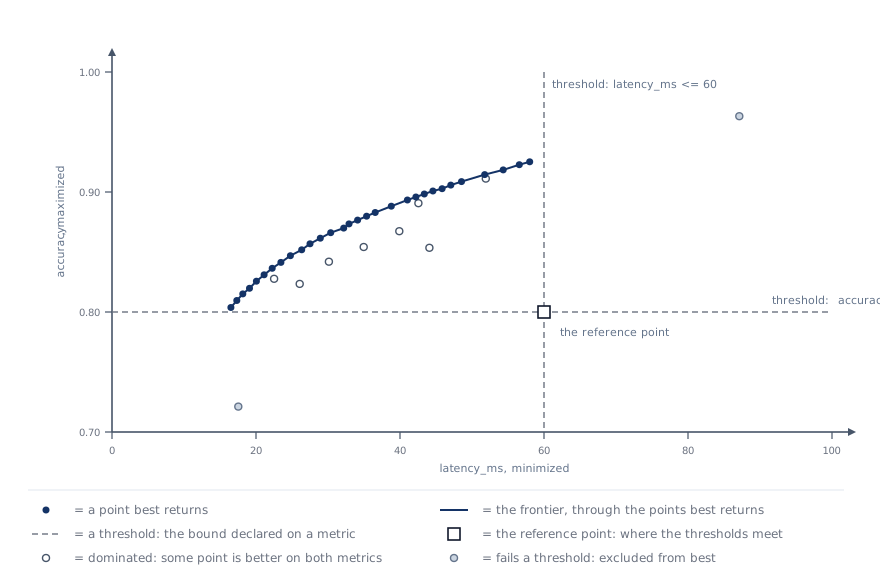
Two optimized metrics on one run: accuracy maximized with a threshold of 0.80, latency_ms minimized with a threshold of 60. The dashed lines are the thresholds; they meet at the reference point the gp_nehvi rung anchors its hypervolume on. best returns the solid blue points, the non-dominated observations among those within both thresholds, and the frontier runs through them. Hollow points are dominated: another observation beats them on both metrics. Grey points fail a threshold and are left out before dominance is tested, the top-right one even though no observation beats it. Measured with the local driver on the multimetric_local.py example family: seed 7, 40 observations, engine 0.4.0.#
from tauopt import ExperimentState, MetricSpec, Parameter, Space
from tauopt.engine import ObservationRecord, derive_objective

metrics = (
    MetricSpec(name="accuracy", goal="max"),
    MetricSpec(name="latency_ms", goal="min", threshold=50.0),
    MetricSpec(name="memory_mb", goal="min", strategy="constraint", threshold=512.0),
    MetricSpec(name="epochs", strategy="store"),
)
space = Space(parameters=(Parameter(name="x", type="double", bounds=(0.0, 1.0)),))
state = ExperimentState(space=space, objective=derive_objective(metrics), metrics=metrics)
rows = [
    ({"x": 0.1}, {"accuracy": 0.90, "latency_ms": 40.0, "memory_mb": 400.0, "epochs": 3}),
    ({"x": 0.2}, {"accuracy": 0.95, "latency_ms": 45.0, "memory_mb": 600.0}),
    ({"x": 0.3}, {"accuracy": 0.97, "latency_ms": 70.0, "memory_mb": 300.0}),
    ({"x": 0.4}, {"accuracy": 0.80, "latency_ms": 20.0, "memory_mb": 300.0}),
]
for a, v in rows:
    state = state.with_observation(ObservationRecord(assignments=a, values=v))
state = state.with_observation(ObservationRecord(assignments={"x": 0.5}, failed=True))
print(state.is_multimetric, [m.name for m in state.optimized_metrics], state.objective)
print([o.assignments["x"] for o in state.pareto_frontier()])
print(len(state.observations), len(state.scored_observations()))
try:
    state.best_observation()
except ValueError as e:
    print("refused:", e)
True ['accuracy', 'latency_ms'] metric='accuracy' goal='max'
[0.1, 0.4]
5 4
refused: multimetric experiment: use pareto_frontier(), not best
The point at 0.2 is infeasible (memory over the constraint), the point at 0.3 fails the latency threshold, and the two survivors do not dominate each other.
What best means in each mode#
best answers three questions, depending on the experiment. With
one optimized metric it returns the single best feasible scored (non-failed)
observation, where feasible means every constraint metric is satisfied. With
two or more it returns the non-dominated, feasible, threshold-satisfying
frontier, and the scalar progress.best_observation is undefined. With
num_solutions above one (single-objective only) it returns that many
diverse good solutions: a greedy max-min-distance pick in the unit cube,
seeded at the best point, drawn from the top candidates by value. Before any
successful observation the answer is an empty set rather than an error.
Failed observations and noise#
failed=True records an attempt that produced no value; a value alongside
it is refused. Failed rows are excluded from modeling and from best, and
the policy’s space-filling bootstrap counts only successful rows. Failed rows still
count as tried points for deduplication, and the gp_ei rung can be
configured to model the probability of success from them.
from pydantic import ValidationError

from tauopt import ExperimentState, Parameter, Space
from tauopt.engine import Objective, ObservationRecord

space = Space(parameters=(Parameter(name="x", type="double", bounds=(0.0, 1.0)),))
state = ExperimentState(space=space, objective=Objective(metric="loss", goal="min"))
state = state.with_observation(ObservationRecord(assignments={"x": 0.2}, value=0.9, value_stddev=0.1))
state = state.with_observation(ObservationRecord(assignments={"x": 0.6}, value=0.4))
state = state.with_observation(ObservationRecord(assignments={"x": 0.9}, failed=True))
best = state.best_observation()
print(best.assignments, best.value, state.metric_stddev(best, "loss"))
print(len(state.observations), len(state.scored_observations()))
for bad in ({"value": float("nan")}, {"value": 1.0, "failed": True}):
    try:
        ObservationRecord(assignments={"x": 0.1}, **bad)
    except ValidationError as e:
        print("refused:", e.errors()[0]["msg"])
{'x': 0.6} 0.4 None
3 2
refused: Value error, observation value must be finite, got nan
refused: Value error, a failed observation carries no value
Reported noise – value_stddev, or values_stddev per metric, each finite
and positive – enters the GP squared, as a fixed per-point variance. When some
points report a stddev and others do not, the missing stddevs are imputed
at the median of the reported stddevs (or, under gp_ei’s mll_impute
noise mode, at the stage-1 inferred level); when none report, the model
infers one noise level for all. A floor keeps every fit conditioned: the
inferred-noise path always keeps at least the 1e-4 floor; the fixed path
keeps your variances verbatim once base_noise is 0. On the
inferred-noise path the fit’s noise level is constrained to at least the
value resolve_floor_std returns, max(1e-4, base_noise, s2_pooled / stdvs**2) in standardized-variance units, where base_noise defaults to
1e-3 and s2_pooled is the disagreement among repeated assignments; an
explicit base_noise=0 lowers that floor to the 1e-4 numerical minimum
rather than removing it. On the fixed-noise path each reported variance is
raised to at least base_noise times the standardized variance, and there
an explicit zero leaves the reported values verbatim. Repeated assignments
are collapsed to per-point means at fit time with their disagreement folded
into the noise, while the raw rows stay untouched in the record. Values must
be finite: a NaN is refused at the door, never discovered inside a fit.
Field names and defaults are in the strategies and config reference.
Do it: Optimize multiple metrics, Report failures and noise, and Request multiple solutions.